Digital Marketing Blog | SEO and Google Ads

Blog

Our digital marketing blog

Digital Marketing: Your Guide to Online Success

This blog offers you the latest digital marketing strategies, tips and trends to boost your business online. Learn about SEO, social media, email marketing and much more. Become a digital expert!

From Zero to Hero: How Core Web Vitals Transformed Our Organic Ranking

From Zero to Hero: How Core Web Vitals Transformed Our Organic Ranking

The digital ecosystem is unforgiving. In the pursuit of the perfect user experience, Google has established Core Web Vitals and SEO as fundamental pillars. These metrics aren't just numbers; they're the yardstick by which your website's speed, interactivity, and visual stability are measured, directly influencing how the search engine treats you. If you're wondering how to go from mediocre performance to dominant organic ranking, the answer lies in optimizing these three key metrics.

The challenge for many website managers is similar: how to decide which optimization actions to prioritize to achieve the greatest impact in the shortest amount of time? Sometimes, it's difficult to discern which adjustments will make a difference. Fortunately, the Google team has shared a series of practical recommendations applicable to the vast majority of websites, simplifying this decision-making process. Our goal at Click Online 360 is to help you break down and implement this roadmap so your website becomes a model of speed and usability.

Mastering Largest Contentful Paint (LCP)

Largest Contentful Paint (LCP) is the metric that measures the time it takes to load and render the largest main content element on a page. A fast LCP is synonymous with a perception of instant loading, and it's a battle that, according to Google, only half of websites are winning. To transform your LCP, focus on the following:

  1. Immediate Visibility of the LCP in HTML : In most cases, the main content is an image. For the browser to load it quickly, its URL must be easily accessible from the HTML source code without waiting for heavy CSS or JavaScript files to be downloaded and processed.

  2. Prioritize the LCP Resource: Even if you use a standard <img> tag, the presence of multiple <script> elements in the <head> can delay the loading of the LCP image. It's crucial to avoid actions that lower its priority, such as the loading="lazy" attribute. Beware of image optimization tools that apply lazy loading indiscriminately!

  3. Reduce Time To First Byte (TTFB) with a CDN: TTFB is the time it takes for a browser to receive the first byte of the server's response. To minimize this, it's recommended to use a Content Delivery Network (CDN). A CDN serves your content from geographically close locations to your users and uses caching efficiently, dramatically speeding up your website's initial loading time.

Visual Stability with Cumulative Layout Shift (CLS)

Cumulative Layout Shift (CLS) assesses visual stability, specifically how much content shifts unexpectedly while the page loads. A "bad" CLS is frustrating for users and penalized by Google. Approximately 25% of websites still fail to meet this standard.

  1. Define Specific Dimensions: The main cause of shifts or movement is images, ads, and iframes without a defined size. It's vital to set the width and height attributes, or their CSS equivalents. A modern solution is to use the aspect-ratio property, which allows the browser to automatically calculate the height based on the width.

  2. Ensure Bfcache Eligibility : Browser back-forward caching (bfcache) allows pages to load almost instantly using a snapshot. If your page is bfcache-eligible, you eliminate any possibility of layout changes when navigating backward or forward. Check compatibility with Chrome DevTools.

  3. Avoid Unnecessary Animations: Animating elements can shift content, negatively impacting CLS. Google notes that pages with animations are 15% less likely to have a good CLS. If you must animate, use the CSS transform property to ensure smoother transitions and avoid costly redrafts.

Interactivity and Responsiveness: FID/INP

Responsiveness is critical. First Input Delay (FID) measures how quickly a page responds to a user's first interaction. While many sites have good FID, Google is promoting Interaction to Next Page (INP) as its potential successor, which measures the latency of all interactions. The following recommendations are key to improving both:

  1. Divide and Conquer: Long Tasks: Browser tasks that exceed 50 milliseconds block the main thread and prevent a fast response. The trick is to break these long JavaScript tasks into smaller subtasks. This allows the browser to process interactions and rendering updates more quickly.

  2. Remove Unnecessary JavaScript: Too much unnecessary JavaScript creates a competition for tasks that impacts responsiveness. Use tools like Chrome DevTools to audit and remove code that isn't essential for the initial load process, ensuring your page responds smoothly and quickly.

  3. Intelligent Rendering: The rendering process can be expensive. To make updates lighter, Google recommends: avoiding using `requestAnimationFrame()` for non-visual work, keeping the DOM (Document Object Model) size small, and using the CSS `containment` property to isolate areas of the page and improve rendering performance.

Boost your business with cutting-edge SEO strategies

Optimizing Core Web Vitals and SEO isn't a one-off exercise; it's an ongoing discipline that merges technical performance with search engine optimization strategy. At Click Online 360 , we're committed to driving your business's success. Our team of expert professionals has helped businesses of all sizes reach top search engine rankings, leveraging on-page experience as a key differentiator.

We work with a personalized and unique strategy for each client, conducting in-depth analysis with all types of data and statistical tools. If you need advice on prioritizing these actions, implementing technical improvements, and maximizing the impact of Core Web Vitals and SEO on your digital project, our SEO agency in Barcelona is here to help.

  • Cutting-edge SEO strategies

  • Customized strategies for each client

  • We increased results from the first month.

  • Expert SEO Team

Core Web Vitals, the Heart of Your SEO Strategy

Prioritizing the optimization of Core Web Vitals—LCP, CLS, and the upcoming interactivity metric —is crucial. Implementing these Google recommendations effectively will not only help you meet page experience standards but will also transform your organic ranking, attracting high-quality, valuable traffic in the medium and long term. Apply these tips, make better use of your time, and climb the rankings to become a Core Web Vitals and SEO hero in your industry.


At Click Online 360 , we are committed to driving your business's success through cutting-edge SEO strategies designed for growth and profitability. Our team of expert professionals has a proven track record of helping businesses of all sizes reach top search engine rankings. We understand that SEO is essential for ensuring quality traffic in the medium and long term, which is why we work with a personalized approach for each client, conducting a comprehensive audit and in-depth analysis using professional tools.


If you're looking to increase your visibility and sales with demonstrable results and complete transparency, contact our agency. We're ready to design a customized strategy that will help you achieve your specific SEO goals, from on-page optimization and quality link building to strategic content creation.


The European Accessibility Act is now in force: Is your website compliant or at risk of sanctions?

The European Accessibility Act is now in force: Is your website compliant or at risk of sanctions?

In the dynamic world of digital marketing, we're constantly focused on SEO, SEM, and the latest trends. However, one fundamental pillar is no longer a recommendation, but a fully-fledged legal obligation: web accessibility .

Since June 28, 2025, the European Accessibility Act ( EAA ) has been legally enforceable throughout the European Union. If your website isn't adapted, you're not missing a future opportunity; you're assuming a present risk.

What is the European Accessibility Act and why does it affect you NOW?

The EAA is a regulation that requires key digital products and services, such as websites and e-commerce, to be accessible to all people, especially those with disabilities.

For your business, this has two immediate implications:

  • Real Risk of Penalties: Failure to comply with the law can result in significant fines. In Spain, these range from €30,000 to €1,000,000 for very serious violations. A cost that can destabilize any marketing budget.
  • Market Loss: An inaccessible website is closing the door to a global audience of more than a billion people. This is a niche market with considerable purchasing power that, now more than ever, will choose companies that allow them to browse and shop without barriers.

What does web accessibility mean in practice? Your website under the microscope : WCAG 2.1

To comply with EAA , your website must follow the A and AA criteria of the Web Content Accessibility Guidelines ( WCAG 2.1). These principles focus on ensuring your content is:

1. Perceptible: Can your content be seen and heard?

  • Alt text: Not just for SEO! Every image should have a description.
  • Subtitles and transcripts: Essential for your videos and podcasts.
  • Contrast and scalability: Ensures that the text is legible (minimum contrast 4.5:1) and can be enlarged up to 200% without breaking the design.

2. Operable: Is your website easy to use?

  • Keyboard navigation: Your website must be fully functional without a mouse. All buttons and links must be accessible with the Tab key.
  • Motion controls: If you have animations, background videos, or automatic sliders, it's mandatory to offer a pause/play button. This is one of the most common and easiest mistakes to spot.

3. Understandable: Is what you offer understood?

  • Clear language: Avoid jargon and structure information logically.
  • Predictable design: Navigation should be consistent throughout the site.
  • Form help: Clearly indicates errors and offers suggestions for correcting them.

4. Robust: Does it work everywhere?

  • Compatibility: Your website should work correctly with different browsers and assistive technologies (such as screen readers), using standard and well-structured HTML code.

Beyond Implementation: Validations You Can't Forget

It's not enough to make changes. The EAA demands evidence and transparency:

  • Accessibility Audit: Conduct an assessment that combines automated tools (such as Lighthouse or WAVE) with manual testing. A 96% score on an automated test doesn't guarantee compliance!
  • Accessibility Declaration: You must have an official document published on your website stating your level of compliance and providing a contact method.
  • Feedback Mechanism: Provides a clear way for users to report accessibility issues.

Is your business affected?

The law primarily applies to private EU companies that offer digital products and services to consumers, in sectors such as:

  • E-commerce
  • Online banking
  • Transportation services
  • E-books and software

Important: Microenterprises (fewer than 10 employees and less than €2 million in annual turnover) are exempt. However, being accessible remains a huge competitive advantage.

Don't wait any longer: Accessibility is Smart Marketing

If you haven't yet adapted your website, now's not the time to wait. Every day that passes without an accessible website is a legal risk and a lost business opportunity. Accessibility isn't just a technical or legal issue; it's a strategic investment in your brand's reputation and in optimizing the user experience for everyone.

At ClickOnline 360, we believe that successful digital marketing is, by definition, inclusive marketing.

What can you do right now?

Although we don't implement accessibility technically at ClickOnline 360, your digital marketing strategy should consider it. We recommend:

  • Conduct an initial diagnostic: Use free online tools like WAVE or Google's Lighthouse report to get an initial idea of the most obvious errors.
  • Talk to your technical team: Share this information with your web developers. They're key to troubleshooting code issues.
  • Find specialists: If necessary, consider hiring consultants who specialize exclusively in web accessibility auditing and implementation.

Our role is to help you integrate this need into your overall strategy so that your brand is stronger, more inclusive, and aligned with the demands of today's market.

Posicionamiento SEO 2026: Las 5 claves que transformarán Google

SEO Positioning 2026: The revolution that will forever change the way you appear on Google

SEO positioning in 2026 will mark a turning point in the history of digital marketing. Experts already confirm it: artificial intelligence, the gradual disappearance of organic clicks, and conversational search will completely transform the rules of the game.
Below, we'll tell you—according to Search Engine Journal's latest State of SEO 2026 report—what trends will define SEO next year and how Click Online 360 is prepared to help you master this new digital era.

The rise of human content in an AI-dominated world

According to the report, 66.3% of SEO professionals say that creating original content remains the most effective way to achieve results. However, 77.9% fear that AI-generated answers will reduce clicks to websites.
This reveals the great paradox of SEO in 2026: AI is changing everything, but authentic, human, and experience-based content is still king.

The key will be to leverage the concept of EEAT (Experience, Expertise, Authoritativeness, and Trustworthiness): creating content with real experience, proven authority, and maximum credibility. At Click Online 360, we work on this strategy in depth, helping our clients stand out from the avalanche of automatically generated texts.

AI + humans: the hybrid model that will dominate SEO

58.5% of experts plan to combine human input with AI support. Only 22.4% are banking on full automation.
This means that the future of SEO in 2026 will be neither entirely human nor entirely artificial, but rather an intelligent fusion of both worlds.

At Click Online 360, we promote this hybrid approach: we use AI to streamline keyword analysis, technical audits, and strategic planning, but we keep creativity, storytelling, and SEO optimization in the hands of specialists.
This is how we achieve the best of both worlds: technological efficiency and human quality.

Fewer clicks, more visibility: the challenge of “zero-click SEO”

The report reveals experts' greatest fear: 77.9% believe that zero-click searches will be the main challenge of the future.
With new AI-generated results (such as AI Overviews or Search Generative Experience), Google will offer answers directly in the search engine, reducing website visits.

This doesn't mean the end of SEO, but rather a transformation of its objectives. Brands will need to focus on visibility within their own AI environments, optimizing to appear as cited sources, authority references, or brands mentioned in AI-generated answers.

At Click Online 360, we're already implementing strategies geared toward this new model, where what matters isn't just the click, but also the presence, reputation, and digital authority.

Winning strategies to succeed in SEO 2026

The State of SEO 2026 highlights three key pillars that will define success:

  1. Integrate AI strategically. It's not about using tools for the sake of fashion, but rather about knowing where they truly add value.

  2. Boost expert and differentiating content. Human expertise will be the decisive factor that AI cannot replicate.

  3. Measure what really matters. Traffic is still key, but the future is measured in conversions, authority, and brand trust.

At Click Online 360 , our methodology is based on:

  • Customized SEO strategies for each client.

  • Advanced data analysis and use of cutting-edge tools.

  • Measurable actions aimed at real results from the first month.

We increase your visibility, boost your growth, and ensure your business's profitability with a 100% up-to-date approach to SEO positioning for 2026.

A future where authority and experience rule

The report concludes that the SEO sector is in transition, but not in crisis.
The most prepared professionals will be those who learn to balance technology with authenticity, and the companies that invest in long-term strategies will be the ones that survive this revolution.

At Click Online 360, we've been helping companies achieve top search results for years with innovative, personalized, and sustainable strategies.
Because SEO positioning in 2026 won't be a matter of algorithms... but of intelligence, experience, and vision.


These have been the Meta Ads 2025 trends: Meta AI and Advantage+ as key points to maximize ROI

These have been the Meta Ads 2025 trends: Meta AI and Advantage+ as key points to maximize ROI

In 2025, digital advertising has entered a new era: Meta AI is no longer just an optional tool, but the core of Facebook and Instagram Ads strategies . With the growth of tools like Advantage+ , we have the ability to automate, personalize, and scale campaigns like never before, achieving higher ROI with less manual effort.

If you're not yet taking full advantage of Meta Ads' AI , now's the perfect time to do so. In this article, we'll explore the key trends Meta Ads is experiencing in 2025 and how AI and Advantage+ are redefining the way you advertise on Facebook and Instagram.


1. The Evolution of Meta Ads Artificial Intelligence in 2025: Intelligent Automation

Over the past few years, Meta has fully embraced AI-based automation. What once required hours of segmentation, trial, and error, can now be configured in minutes thanks to machine learning systems that analyze thousands of user signals in real time.

In 2025, Advantage+ campaigns will consolidate their position as the flagship format. These campaigns use AI to make decisions about:

  • Who to show ads to (automatic targeting).
  • Which creatives work best (dynamic optimization).
  • How much to invest in each audience or location (smart budgeting).

The result is more efficient, personalized, and cost-effective advertising , even for companies with modest budgets.


2. What is Advantage+ and why is it key?

Advantage+ is Meta Ads' advanced automation toolset . It combines AI algorithms with deep learning to improve campaign results at all stages.

Its main functions include:


  • Advantage+ Shopping Campaigns

Designed for eCommerce, these campaigns use AI to show the most relevant ads to users most likely to buy. Meta analyzes the behavior of millions of people to adjust ad delivery in real time, maximizing ROAS (Return on Ad Spend).

  • Advantage+ Audience

Allow Meta's AI to select the best audience based on behavioral, interest, and conversion data. While you can include a base audience, the platform automatically expands targeting to users who are more likely to convert.

  • Advantage+ Creative

Automatically optimize your ads: Test combinations of text, headlines, images, and calls to action to show the most effective version to each user.


The approach is clear: less micromanagement, more data-driven results.


3. How to use Meta's artificial intelligence to maximize ROI

Harnessing the power of AI in Meta Ads isn't just about activating Advantage+ and waiting for results. The key is to properly fuel the system and monitor the signals the AI uses to learn. Here are the essential steps:

1. Correctly configure the pixel and the conversion API

Meta's AI is data-driven. If your pixel or API isn't properly configured, the platform won't be able to optimize conversions properly. Make sure all important events (purchase, lead, add to cart, etc.) are measured and verified.

2. Provide quality content

While AI does much of the work, it's still essential to deliver powerful creative: engaging images, short videos, clear copy, and effective calls to action. AI optimizes, but it can't improve an ad that doesn't connect.

3. Leave room for learning

Avoid making drastic changes during the learning phase. Every time you change budget, audience, or creative, you restart the optimization process. Let the AI gather enough data before adjusting.

4. Use Advantage+ Budget to optimize investment

Allows Meta to automatically manage your budget across different ad sets, allocating more investment to those that generate the best results. This significantly improves your cost per acquisition (CPA) and overall ROI.


4. Key metrics to measure success with AI and Advantage+

While AI automates much of the process, it's important to monitor the right metrics to assess the real impact on your profitability:


  • ROAS (Return on Ad Spend): measures the profitability of advertising investment.
  • CPA (Cost per Acquisition): how much you pay for each conversion.
  • CTR (Click-Through Rate): indicates the relevance of the ad.
  • Frequency and reach: Make sure you don't overwhelm your audience.
  • Post-click conversion rate : Analyze whether your landing page or e-commerce site supports the ad experience.

Meta Ads 2025 isn't just about spending less, it's about investing more intelligently by correctly interpreting the data generated by AI.


5. Key Meta Ads Trends

  • Generative AI applied to creatives: Meta now allows for automatic variations of text and images based on performance.
  • Greater integration with WhatsApp Ads: AI will recommend when to use direct messages as a conversion channel.
  • Predictive optimization: AI models will anticipate purchasing trends and adjust campaigns before results change.
  • Private audiences and first-party data: With the end of cookies, Meta prioritizes strategies based on advertiser data.
  • Unified cross-platform analysis: Combine results from Facebook, Instagram, WhatsApp, and Threads under a single dashboard.


6. Expert advice for agencies and advertisers

  • Start with mixed campaigns: Combine Advantage+ with manual campaigns to compare results and adjust strategies.
  • Build a UGC (user-generated content) creative bank: The most authentic ads are still the ones that convert the best.
  • Train your team in data analysis: AI does the heavy lifting, but professionals must interpret and decide.
  • Experiment with small budgets: AI learns from data, not from overspending. Start small and scale what works.


Conclusion

In 2025, the combination of AI and professional creativity is the true competitive advantage. Tools like Advantage+ allow advertisers to focus more on strategy and less on technical management, achieving more efficient campaigns with better ROI.

The challenge is no longer knowing how to use Meta Ads, but rather leveraging its artificial intelligence strategically. Brands that understand how to fuel, measure, and adjust their campaigns with AI will dominate the next generation of digital marketing.

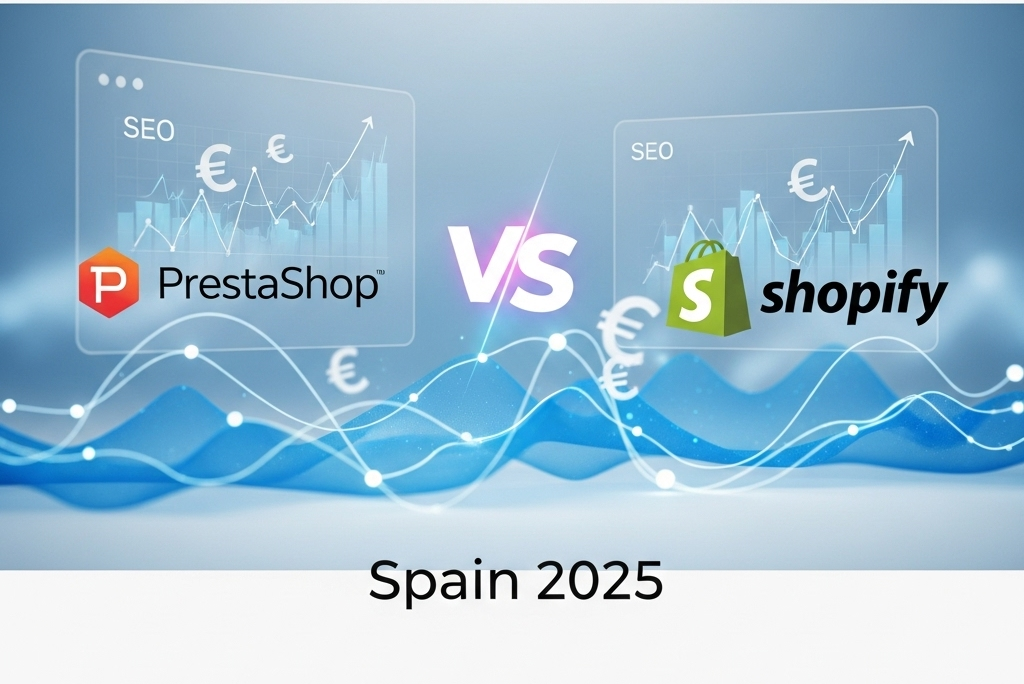
PrestaShop vs. Shopify in 2025: The Honest Comparison for Businesses in Spain

PrestaShop vs. Shopify in 2025: The Honest Comparison for Businesses in Spain

Deciding which platform to use to launch or migrate an online store is one of the most critical decisions for a business in Spain. In 2025, two titans continue to dominate the landscape: PrestaShop , the bastion of open source software and total customization, and Shopify , the SaaS (Software as a Service) giant. But which is really the best option for the Spanish market, especially if SEO and long-term control are your priorities?

This honest comparison breaks down the three key areas that matter most to merchants: actual costs, SEO potential, and flexibility to grow, with a special emphasis on why PrestaShop often becomes the strategic choice for serious businesses.

The Quick Verdict: Who Is Each Platform For?

  • Shopify is for you if: You prioritize launch speed and ease of use above all else. It's ideal for entrepreneurs and startups who want an all-in-one solution without technical complications, assuming a recurring monthly cost and certain limitations in customization and advanced SEO.
  • PrestaShop is for you if: You're looking for maximum customization and complete control over your project . It's the preferred option for businesses that understand the value of SEO, plan a long-term strategy, and want to own their technology without paying sales commissions.

1. The Battle of Real Costs: Owning vs. Renting?

This is where the difference in model is most evident. With PrestaShop, you own your home; with Shopify, you rent a luxury apartment.

Shopify: The Convenience of Subscription (and Its Hidden Costs)

With Shopify, you pay a monthly fee that includes hosting, security, and support. It's predictable, but can scale quickly.

  • Monthly Plans (2025): Basic (~€36/month), Shopify (~€105/month), Advanced (~€384/month).
  • The Deciding Factor: Fees. If you don't use Shopify Payments and opt for a Spanish gateway like Redsys, Shopify penalizes you with an additional fee on each sale: 2% on the Basic plan, 1% on the Shopify plan, and 0.6% on the Advanced plan . This fee is in addition to what your bank already charges you.
  • Additional Costs: Advanced features (especially for SEO and marketing) require monthly paid apps , which can easily add €50-€150/month to your bill.

PrestaShop: Initial Investment for Total Freedom

PrestaShop is free to download, but requires an investment to get up and running. The big advantage: once set up, the fixed costs are minimal and there are no sales fees.

  • Infrastructure Costs: You'll need PrestaShop-optimized hosting (€10-€30/month in Spain) and a domain (€15/year).
  • Essential Modules (Single Payment): Here you invest at the beginning to save for the long term.
    • Payment Gateway (Redsys): ~€40 - €70.
    • Advanced SEO: ~€100 - €200.
    • Legal Compliance (GDPR): ~€70.
  • Maintenance: You're responsible for security and updates. You can do this yourself or hire maintenance (~€50-€200/month), a cost that's often still lower than the combined cost of apps and Shopify fees for a mid-sized store.

Cost Conclusion

Shopify is a recurring operating cost that grows with your sales. PrestaShop is a capital investment (asset) that gives you freedom and a much lower and controlled maintenance cost over the long term, without penalizing your growth with higher fees.


2. SEO: The Big Difference. PrestaShop's Flexibility vs. Shopify's Rigidity

This is where PrestaShop proves its superiority for any business serious about organic growth. Shopify offers a solid foundation for beginners, but its structural limitations are a glass ceiling for advanced SEO strategies.

Shopify SEO Limitations: The Walled Garden

Shopify is designed to be simple, but with that simplicity comes rigidity.

  • Fixed and Immutable URL Structure: This is perhaps its biggest weakness. You can't remove the /products/ , /collections/ or /pages/ prefixes from your URLs. This prevents you from creating a clean, advanced web architecture (siloing), which is essential for organizing content and ranking competitive categories. In PrestaShop, you have complete control over every part of the URL , allowing for perfect optimization.
  • Hreflang Management and International SEO: While PrestaShop natively manages multi-language and multi-store functionality from a single dashboard (making it much easier to implement hreflang tags for international markets), Shopify relies on paid apps or complex subdomain-level solutions that aren't always ideal for SEO.
  • Limited Control Over Structured Data (Schema): Shopify and its themes generate basic structured data, but if you want to fully customize it (for example, to add niche-specific schemas), you'll again rely on paid apps that are often limited. With PrestaShop, you have full access to the code to implement perfect, custom Schema markup.
  • Zero Server Access: Forget about optimizing your .htaccess file for advanced redirects or implementing server-level caching rules. You're locked into the tools Shopify provides.

The Power of Total Control with PrestaShop

PrestaShop gives you the keys to the SEO kingdom. Anything an SEO specialist can imagine can be implemented.

  • Custom Web Architecture: Define clean and logical URL structures that reinforce the authority of your main categories.
  • Native International SEO: Efficiently manage different languages and countries, a key point for businesses in Spain that sell in Europe.
  • Deep Web Optimization (WPO): By choosing your own hosting, you can implement the latest caching technologies (Varnish, Redis), optimize your database, and have full control over Core Web Vitals, something that is a black box with Shopify.

3. Task Automation: The Open Ecosystem vs. Pay-Per-App

Automation is key to scaling, and here the approach of both platforms is radically different.

The Difficulty of Automating SEO on Shopify

At Shopify, automation relies almost exclusively on the App Store. Want to generate meta descriptions in bulk? You need one app. Optimize the ALT text of thousands of images? Another app. Create advanced redirect rules? Yet another. This not only drives up monthly costs , but also creates a dependency on multiple third-party developers. The system is designed to make you pay for every new feature, limiting your ability to create truly customized workflows.

Unlimited Automation in PrestaShop

PrestaShop's open source ecosystem offers unmatched flexibility.

  • All-in-One Modules: You can purchase an advanced SEO module (one-time payment) that centralizes dozens of tasks: template-based meta tag automation, advanced sitemap generation, 404 redirect management, and much more. The long-term cost-benefit ratio is immense.
  • Custom Scripts: With access to the database and code, a developer can create custom scripts to automate unique tasks for your business. For example, a script that automatically optimizes images when uploaded with a specific format and weight, or that updates prices and stock from a third-party supplier in a very specific way. This is unthinkable with Shopify.
  • Direct Integrations: The ability to connect PrestaShop directly to ERPs and other management tools without relying on a paid monthly app "connector" gives you much greater control and operational efficiency.

Final Conclusion: Which Platform Will Win in Spain in 2025?

There is no absolute winner, but rather a right choice for every type of business and level of ambition.

Choose Shopify if:

  • You need to launch in days and ease of use is your only priority.
  • Your SEO strategy isn't too ambitious, and you're happy with the basic features.
  • You prefer predictable monthly spending and don't mind giving up technical control and paying sales commissions.

Choose PrestaShop if:

  • You understand that SEO is a fundamental pillar of your business and you want maximum control to outperform your competition.
  • You're looking to build a long-term digital asset , being the sole owner of your platform, your data, and your future.
  • You want a scalable, more cost-effective solution, free of sales fees and with the ability to automate and customize without limits.

For the Spanish market, where online competition is fierce, the ability to differentiate yourself through impeccable technical SEO and a unique user experience is key. And in this field, the freedom and power of PrestaShop remain, in 2025, the strategic choice for businesses aspiring to lead their niche.

SEO Positioning: The Most Common Mistakes When Relying on AI Without a Strategy

SEO Positioning: The Most Common Mistakes When Relying on AI Without a Strategy

There is no translation available.

When working on SEO, it’s inevitable to come across the notion that artificial intelligence (AI) will replace everything. But beyond the hype, there are myths that can hold back your growth if you believe them.
Below, we debunk the most common myths about the relationship between SEO and Artificial Intelligence, and show you how at Click Online 360 we apply a balanced, professional approach to achieve real results.

SEO remains a key piece of any digital strategy, even in the age of AI. When you mention SEO positioning in your strategic decisions, it’s normal to wonder: will AI do it all? Is it worth investing in SEO consultants if AI “takes care of it”? At Click Online 360, with our long experience in the sector, we know that many of these beliefs are myths that can stand in your way.

Here we share the most dangerous myths about SEO and Artificial Intelligence—and how to avoid them.

Myth 1: AI can fully automate SEO

This is perhaps the most widespread myth: believing that a “SEO robot” or smart software can do everything for you—analysis, content creation, link building, technical optimization—and voilà, your rankings will rise.
The reality is that while there are AI-based tools that automate specific tasks (keyword research, optimization suggestions, idea generation, etc.), no tool can replace human strategy, expert oversight, or business context.

A solid SEO strategy requires understanding your business model, analyzing competitors, defining goals, prioritizing actions, and adapting to Google’s changes. AI helps, but it doesn’t replace. Many agencies offer “fully automatic SEO,” but this often results in mediocre content or simplistic tactics.

Myth 2: AI-generated content is low quality or penalized

Another common myth is thinking that Google penalizes all AI-written content or that all automatically generated content is irrelevant. In some older cases, this might have been true, but today’s language models have advanced greatly, and with human supervision can produce very useful and optimized content.

What matters is not whether the content was generated by AI, but whether it provides value, meets E-E-A-T criteria (experience, expertise, authority, and trust), and satisfies user search intent. If the content is poor, duplicated, or without unique value, it can indeed cause issues—but the same happens with poorly crafted human content.

At Click Online 360, we use AI to support brainstorming, drafts, and suggestions, but a specialist writer always steps in to add judgment, unique voice, and validation.

Myth 3: With AI, you don’t need SEO professionals anymore

Some believe it’s no longer necessary to hire agencies or consultants because AI will do everything. But this is wrong: AI lacks the strategic vision, holistic oversight, and deep technical knowledge that a good SEO professional provides.

SEO professionals will not disappear; they simply evolve. At Click Online 360, we apply AI, advanced tools, and human analysis to deliver complete strategies—technical, content, linking, user experience—tailored to your needs.

Myth 4: Just stuffing keywords and AI will rank you

This myth combines two fantasies: that AI automatically ranks content, and that keyword stuffing guarantees rankings. Neither is true. SEO requires a balanced effort of relevance, context, intent, and quality.

Repeating a keyword too many times (“keyword stuffing”) can hurt you more than help you. AI can suggest where to place terms, but the text must flow, provide value, and respond to the user’s real intent.

Myth 5: Once AI is implemented in SEO, you’re done

Believing AI is a static solution is dangerous. SEO is a living process: Google updates its algorithms, competitors move, search trends change. AI can help you react faster to these changes, but it’s not a “set-and-forget” solution.

Those who believe this myth fall into the trap of thinking SEO and AI are immediate and permanent solutions. At Click Online 360, we monitor results, test, adapt, and continuously optimize, with AI as an ally.

How Click Online 360 truly integrates SEO and Artificial Intelligence

At Click Online 360, we have years of experience combining technology, strategy, and creativity to position brands. Our approach when we talk about SEO and Artificial Intelligence is based on:

  • Strategic diagnosis: before using AI, we analyze business, audience, competition, gaps, and opportunities.

  • Selection of reliable AI tools: we use tools that assist with keyword research, on-page optimization, audits, detection of technical errors—but without blind reliance.

  • Expert human oversight: everything generated by AI is reviewed, edited, and adapted by SEO specialists to ensure alignment with brand, voice, and goals.

  • Testing, monitoring, and continuous improvement: we introduce improvements, track key metrics (traffic, conversions, rankings), and adjust strategies.

  • Training and guidance: we help clients understand how SEO and AI work together—and avoid myths that slow growth.

Dispelling the myths surrounding SEO and AI is essential to move forward without false expectations. AI is not a silver bullet or a full replacement: it is a powerful tool that, when used alongside human expertise, takes your SEO to another level.

At Click Online 360, our mission is to guide you through this technological transition with rigor, strategy, and experience. If you want an honest SEO audit and a smart plan that leverages the best of AI without losing control, we’re ready to help.

The Future of Search Is Here: Google Introduces AI Mode and Redefines What It Means to Search

For decades, the verb "to search" in the context of the internet has been intrinsically linked to Google. Since its inception, the Mountain View giant has taught us to ask questions, refine keywords, and navigate a vast network of information. But what if I told you that definition of "search" is about to become obsolete? Google, the eternal innovator, has just unveiled what many consider the next great evolutionary leap: "AI Mode" in its search engine. And at ClickOnline, always keeping an eye on the latest technological trends that transform our daily lives, we couldn't be more excited to tell you all the details.

Beyond Links: From Search Engine to Intelligent Agent

Until now, our interaction with Google was based on a "question-answer-links" model. We would ask a question, and Google would offer us a list of websites that might have the answer. The work of synthesis and final action fell to us. However, "AI Mode" radically changes this dynamic. Google no longer just gives you information; it understands it, synthesizes it, and even acts on your behalf. We're talking about a transformation from a mere "search engine" to a true "intelligent agent."

This "AI Mode" is powered by Google's most advanced AI models, including the powerful Gemini family. These models are not only capable of understanding natural language in an incredibly sophisticated way, but can also reason, plan, and execute complex tasks.

The Capabilities That Will Transform Your Search Experience
Imagine the possibilities. Here's a breakdown of the key features that make AI Mode revolutionary:

1. Agent Capabilities: Your Integrated Personal Assistant

This is where AI Mode really shines. You no longer need to jump between tabs to plan an outing. Now you can tell Google something like, "Find me a good tapas restaurant near the Gothic Quarter for this Friday night that has vegetarian options, and book a table for two."

And Google will do the following:

It will understand your full intention: Not just "restaurant," but "tapas," "vegetarian," "near the Gothic Quarter," "Friday night," and "table for two."

It will conduct real-time research: It will search for restaurants with those characteristics, checking availability on different booking platforms (such as TheFork or directly at the restaurant).

It will present options: It will show you a couple of suggestions with their menus, approximate prices, and ratings.

It will make things easier: With just a few clicks, you can confirm your reservation directly from the search page, without having to visit individual restaurant websites.

This is a paradigm shift. Google becomes your digital copilot, capable of taking actions delegated to you, streamlining everyday tasks and freeing up your time.

2. Multimodality: Speak, Show, Search

The way we interact with technology is becoming more and more natural. "AI Mode" embraces this trend with multimodality:

Voice Search: Ask your questions orally, as if you were talking to a person.

Image search: Have you seen an exotic plant and want to know its name? Upload a photo. Love a piece of furniture in a magazine? Scan it with your camera.

Camera integration: Point your phone at a dish you like on a foreign menu and ask Google what ingredients it contains or if there are similar options in your city.

AI is designed to understand context regardless of the format of your input, opening up a range of faster and more intuitive search possibilities.

3. Advanced Customization (With Your Permission)

AI Mode has the potential to be incredibly personal and useful, always under your control and with your explicit permissions. If you authorize it, it can integrate information from other Google apps you already use. For example:

If you have a flight or hotel reservation in your Gmail, Google might suggest activities, attractions, or restaurants near your destination, or even remind you of the best time to leave for the airport.

If you use Google Calendar, it can help you plan an event based on your availability.

This means that the answers will be much more relevant to you specifically, tailored to your context and individual needs.

4. Deep Search: The Expert at Your Disposal

For those complex questions that require more than a quick answer—a school project, research for work, or simply the curiosity to understand a topic thoroughly—AI Mode introduces Deep Search. Instead of presenting you with ten links to read, the AI is able to:

Analyze hundreds of sources: You will navigate through a vast amount of information on the web.

Synthesize and organize: You will extract key points, relate them, and present them coherently.

Produce comprehensive reports: You could generate a lengthy summary on a topic, structured with different sections and, crucially, citing all your sources clearly.

Imagine having an expert researcher at your disposal, capable of condensing hours of reading into minutes.

5. Dynamic and Intuitive Interface

Forget the static results page with ten blue links. AI Mode will offer a much richer and more adaptable interface. Answers can be combined with:

Explanatory text: Direct and concise answers.

Images and videos: Relevant visual content to illustrate the information.

Interactive Maps: For geographic or local business searches.

Further links: These will always be available so you can explore the original sources if you wish.

All of this, presented in a visually appealing and easy-to-consume format.

The Impact for Users and Businesses

AI Mode will not only change how we use Google, but will have a significant impact on how businesses approach their online presence:

For users : It means greater efficiency, smarter and more personalized responses, and the ability to perform complex tasks with less effort. Search becomes less of a "task" and more of a "conversation" or "delegation."

For businesses : It demands a new SEO and content strategy. It will no longer be enough to appear in the top results; it will be crucial that content is accurate, verifiable, and structured in such a way that AI can understand it and use it to generate its own answers. "Zero visibility" (when the answer is given directly on the Google page) will become an even more palpable reality, and the quality and authority of content will be more important than ever.

The Beginning of a New Era

"AI Mode" is an experiment, yes, but one that is already shaping the future direction of internet search. Google is fundamentally redefining its role in our digital lives, shifting from a library of information to a conversational and transactional interface.

At ClickOnline, we're ready to explore this new landscape, help you understand its implications, and ensure your business and digital life are at the forefront of this exciting evolution. The future of search has arrived, and it's smarter than we ever imagined!

What do you think of this new era of Google Search? Are you ready for "AI Mode"?
How to optimize your website with Generative Engine Optimization in 5 steps

How to optimize your website with Generative Engine Optimization in 5 steps

Generative Engine Optimization has become one of the most relevant trends in the world of digital positioning. This evolution of traditional SEO redefines how artificial intelligence-based search engines—such as generative systems—select and cite information in their responses.

Below, we'll explain what Generative Engine Optimization is and how to apply it to your website through a practical, 5-step tutorial.

What is Generative Engine Optimization (GEO)?

The concept of Generative Engine Optimization refers to techniques aimed at improving a website's visibility within generative AI engines. Unlike traditional SEO, which works to achieve better rankings in search engines like Google, GEO seeks to influence the responses produced by artificial intelligence systems, ensuring that your website's content is cited as a reliable source.

Some key elements of this emerging discipline are:

  • AI-specific metadata that guides generative models in interpreting content.

  • The use of files like llms.txt, intended to indicate which parts of the site can be used by language models.

  • The clear, quotable structure of the content, designed to be integrated into narrative and conversational responses.

In this sense, Generative Engine Optimization is already an essential part of the strategy of any business that wants to gain visibility in the era of synthetic and conversational search.

Why choose Generative Engine Optimization?

  1. Visibility in AI responses
    Conversational engines prioritize clear and useful answers. Applying GEO increases your chances of appearing as a cited source.

  2. Adapting to new user habits
    More and more people are relying on generative search engines instead of traditional results. Being optimized for GEO means speaking the language of the present and the future.

  3. Differentiation and long-term results
    Implementing Generative Engine Optimization not only improves your ranking, it also gives you more control over how your brand is presented in generative environments.

How to optimize your website with Generative Engine Optimization in 5 steps

Step 1: Use AI-specific metadata and files

Create an llms.txt file, similar to the well-known robots.txt file, but geared toward generative models. In it, you can indicate which sections of your website can be analyzed and cited by artificial intelligence. Also add clear and consistent metadata.

Step 2: Structure your content to be citable

Divide your content into clear sections, use headings, lists, and concise sentences. Generative engines need to easily identify text fragments that can be integrated into a narrative response.

Step 3: Respond to the user's search intent

The content should directly answer users' questions. It's advisable to include FAQs, how-to guides, and simple explanations. Clarity and conciseness are key in Generative Engine Optimization.

Step 4: Integrate GEO with traditional SEO

Don't abandon the SEO techniques that already work: relevant keywords, technical optimization, quality backlinks, and useful content. GEO should work hand in hand with traditional SEO to ensure visibility in both traditional and generative search engines.

Step 5: Continuously monitor and adjust

Analyze how your presence in generative engines is evolving and adjust your strategy. Generative Engine Optimization is a constantly evolving field, so it's essential to adapt techniques quickly.

The value of Click Online 360 in your GEO strategy

At Click Online 360, we understand that SEO is undergoing a transformation. That's why we combine our expertise in web positioning with the most innovative trends, such as Generative Engine Optimization.

Thanks to our team, your business will be able to:

  • Identify real opportunities to appear in generative responses.

  • Create optimized and structured content to be cited by AI models.

  • Integrate GEO with robust and customized SEO strategies.

  • Maintain your brand's visibility in a digital environment that changes every day.

Trusting Click Online 360 means investing in cutting-edge SEO , capable of guaranteeing presence in both traditional search engines and generative engines.

Generative Engine Optimization is a necessary evolution of SEO. Implementing this strategy on your website through clear steps—metadata, structure, user intent, integration with traditional SEO, and monitoring—will allow you to gain visibility in generative AI engines.

At Click Online 360, we're ready to guide you through this transition and position your brand as a trusted source in the new era of digital search.


Go Online! Your Step-by-Step Guide to Creating a Successful eCommerce Site with PrestaShop

Go Online! Your Step-by-Step Guide to Creating a Successful eCommerce Site with PrestaShop

Have you always dreamed of having your own online store, but don't know where to start? You've come to the right place! In today's digital age, selling online is more accessible than ever. And if you're looking for a robust, flexible, and open-source solution for your eCommerce, PrestaShop is an option you should seriously consider.

In this guide, we'll walk you through the key steps for launching your online store, focusing on why PrestaShop is the ideal platform for your project and how to get the most out of it.

---

How to Start a Successful eCommerce Site with PrestaShop: A Step-by-Step Guide

Step 1: Define your Niche and Business Plan

Description: Before diving into the technical side, it's crucial to have a clear vision of what you want to sell and to whom. Research the market, identify your target audience, analyze your competition, and define your unique value proposition.

What you need to do:

  • Research profitable market niches.
  • Identify your ideal client (buyer persona).
  • Perform a SWOT analysis (Strengths, Weaknesses, Opportunities, Threats).
  • Create a basic business plan that includes your goals, marketing strategies, and financial projections.

Step 2: Choose your Store Name and Register your Domain

Description: Your store name is your online identity. It should be memorable, easy to remember, and relevant to your products. Once you have it, register it as your web domain.

What you need to do:

  • Brainstorm catchy and available names.
  • Check domain availability (look for a ".com," ".es," or an extension relevant to your business).
  • Register your domain through a trusted provider.

Step 3: Select your Hosting Provider

Description: Your online store needs a place to "live" on the internet. Choose a reliable hosting provider that offers good performance, security, and technical support.

What you need to do:

  • Compare different hosting providers (look for those optimized for PrestaShop).
  • Consider factors such as disk space, bandwidth, RAM, and SSL support.
  • Hire a hosting plan that suits your needs.

Step 4: Install PrestaShop on your Hosting

Description: This is where PrestaShop comes in! Most hosting providers offer one-click installation for PrestaShop, which makes this process much easier.

Why PrestaShop?

  • Free and Open Source: There are no initial licensing costs, making it ideal for startups.
  • Great Community: Access to forums, tutorials, and developers who can help you.
  • Powerful and Flexible: Capable of handling everything from small to large stores, with a vast amount of modules and themes.
  • SEO Friendly: Allows you to easily optimize your products and pages for search engines.
  • Multilingual and Multi-Currency: Ideal if you plan to expand internationally.
  • Complete Management: Total control over products, orders, customers, stock and marketing.

What you need to do:

  • Access your hosting control panel (cPanel, Plesk, etc.).
  • Look for the "Auto Installer" or "Applications" option and select PrestaShop.
  • Follow the steps to complete the installation.

Step 5: Configure your PrestaShop Store and Optimize Content

Description: Once you've installed PrestaShop, it's time to customize your store, upload your products, and ensure that both the design and content are optimized for your users and search engines.

What you need to do:

  • General Settings: Set your store's currency, primary language, contact information, time zone, and other basic settings that will govern overall operation.
  • Design and Theme: Choose a PrestaShop theme that not only reflects your brand's aesthetic, but is also responsive and offers a great user experience on any device. You can opt for free themes or invest in a premium theme with more features and support.
  • Design your Category Tree: Before uploading products, take the time to structure your categories in a logical and hierarchical way. An intuitive category tree will make it easier for your users to navigate and help search engines index your content correctly. Think about how a customer would search for your products.
  • Research and Apply Keywords: Conduct thorough keyword research related to your project and the products you offer. Use these keywords naturally in product titles, descriptions, categories, and blog content to improve your search engine visibility.
  • Upload Your Products: Add each product with **detailed and unique descriptions**, high-quality images (with descriptive alt text), prices, variants (sizes, colors, materials), attributes, and inventory control. The more valuable information, the better for both the user and SEO.
  • Configure Payment Methods: Integrate secure and popular payment gateways in your region, such as PayPal, Stripe, bank transfers, or cash on delivery. Offering a variety of options will increase your conversion rate.
  • Define Shipping Methods: Establish your shipping zones, integrate trusted carriers, and configure shipping costs. Be transparent about delivery times and rates to avoid customer surprises.
  • Create Essential Legal Pages: It's essential to have clear and accessible pages for "Legal Notice," "Privacy Policy," "Terms and Conditions of Purchase," and "Return Policy." This builds customer trust and complies with legal regulations.

Step 6: Basic SEO Optimization for PrestaShop

Description: To help your customers find you, you need to let Google and other search engines know you exist. PrestaShop makes SEO optimization easy.

What you need to do:

  • Friendly URLs: Enable rewritten URLs in PrestaShop to make them human-readable and contain keywords.
  • Meta Titles and Descriptions: Fill in these fields for each product and page, including relevant keywords.
  • Optimized Images: Use descriptive alt text for your images.
  • Quality Content: Write unique and detailed product descriptions. Consider creating a blog integrated with PrestaShop.
  • Install SEO Modules: PrestaShop has modules that can help you further improve your rankings.

Step 7: Perform Thorough Testing

Description: Before launching, it's crucial that you test every aspect of your store to ensure a flawless user experience.

What you need to do:

  • Make test purchases from start to finish.
  • Check all payment methods.
  • Check the customer registration and login process.
  • Make sure confirmation emails are sent correctly.
  • Test the store on different devices (mobile, tablet, desktop).

Step 8: Launch Your Store and Promote It!

Description: Once everything is perfect, it's time to open the doors of your online store to the world and start attracting customers.

What you need to do:

  • Disable maintenance mode in PrestaShop.
  • Promote your store on social media.
  • Consider online advertising campaigns (Google Ads, Facebook Ads).
  • Send newsletters to your subscriber list (if you already have one).
  • Keep optimizing your SEO and generating valuable content.
---

Your eCommerce Journey Starts Now!

Starting an eCommerce business can seem like a daunting task, but with a step-by-step approach and choosing a robust platform like PrestaShop , the path becomes much clearer. Remember that the key to online success lies in consistency, adaptability, and the ability to deliver an excellent customer experience.

Ready to take the plunge? PrestaShop is waiting for you with all the tools you need to build the online store of your dreams!

SEO in the Age of AI: What to Expect from Google in the Coming Months

SEO in the Age of AI: What to Expect from Google in the Coming Months

The evolution of search engine optimization has always been linked to technological progress. From initial keyword-focused algorithms to user-experience-oriented updates, Google has constantly redefined the rules of SEO. Today, we are facing a new transformation: the emergence of artificial intelligence (AI) as a leading player in the search ecosystem.

What impact will this revolution have on the way we optimize content? What priorities will Google set in the coming months? In this article, from Click Online 360, a specialized SEO agency , we analyze how to adapt to SEO in the era of AI and what to expect in the short term.

The new era of search: Google bets on AI

Over the past few months, Google has made it clear that artificial intelligence is not a passing fad, but rather the core of its technological evolution. The implementation of SGE (Search Generative Experience), a new AI-powered search experience, is radically changing the way users interact with the search engine.

With SGE, results are no longer limited to a list of links: they now display complete, AI-generated answers, with synthesized content, added context, and complementary links. Although it is still being tested in many countries, its full implementation will be a game-changer for SEO strategies.

What is Google communicating about the future of SEO?

During the Google I/O 2025 event, the company shared some key messages about how it will face this new era:

  • Original, human content will continue to be essential. While AI can generate texts quickly, Google will place much greater value on unique, useful content created by people with real experience.

  • Better understanding of search intent. Thanks to models like Gemini, search engines will be able to interpret more complex or conversational searches and offer more relevant answers.

  • Greater emphasis on authority and expertise. Especially on sensitive topics like health, legal, or finance, Google will prioritize reliable sources and expert authors.

Key Changes for SEO in the Age of AI

As search evolves, so do SEO practices. These are the areas we'll need to keep in mind:

1. AI-generated content requires human oversight

Automatic writing tools are useful for structuring ideas, but Google penalizes content created without human intervention. The key is to enrich your texts with analysis, real-life cases, and original contributions.

2. The EEAT gains prominence

The concept of EEAT (Experience, Expertise, Authoritativeness, Trustworthiness) has been reinforced as a pillar for evaluating content quality. What can you do?

  • Author articles with real, experienced authors.

  • Include practical examples or testimonials.

  • Demonstrate authority in your industry through consistent, well-researched publications.

3. Technical SEO will be more crucial than ever.

To help the search engine understand your content better, you'll need to work on:

  • Correct use of structured data ( Schema.org ).

  • Fast loading speed.

  • Clear architecture and optimized mobile experience.

Websites with a strong technical foundation will have a better chance of appearing in new AI-generated snippets.

4. The CTR of organic results could decrease

With AI offering complete answers from within the search results themselves, many users won't click on traditional links. To compensate for this, it will be necessary to:

  • Optimize titles and descriptions in an attractive way.

  • Deliver deeper content than AI can synthesize.

  • Include interactive elements (calculators, videos, tools, etc.) that cannot be easily replicated.

How to adapt your SEO strategy to the new environment

From Click Online 360, we give you some practical recommendations to start adapting to this new era of SEO today:

  • Create expert content, not generic content. Depth, specialization, and added value will make the difference.

  • Use AI as a support, not a substitute. Use it for mechanical tasks, but be sure to review, correct, and personalize your texts.

  • Strengthen your technical SEO. Improve your site's structure, improve loading speed, and optimize for mobile.

  • Measure and adjust. Constantly monitor user behavior and adapt your content based on their changing search patterns.

  • Follow Google's official guidelines. Staying up-to-date is more important than ever.

Are we facing the end of SEO?

No. We're witnessing a transformation. SEO isn't disappearing, it's being redefined. Artificial intelligence, properly understood, can be a powerful tool for improving user experience and delivering truly useful content.

At Click Online 360, we've been anticipating changes to Google's algorithm for years. We know that success depends not only on generating traffic, but also on attracting qualified, relevant, and profitable traffic.

Do you want your website to stay at the top of search results?

At Click Online 360, we work with cutting-edge SEO strategies , tailored to each client:

  • We increase your results from the first month.

  • We create customized strategies with in-depth analysis.

  • We have a team of experts in technical SEO, content, and conversion.

The future of SEO is here. Are you ready to lead it?
Contact us and take your online visibility to the next level.